
LLMO, or large language model optimization, is the practice of refining content to appear within large language model answers like those from ChatGPT, Google Gemini, and Perplexity.
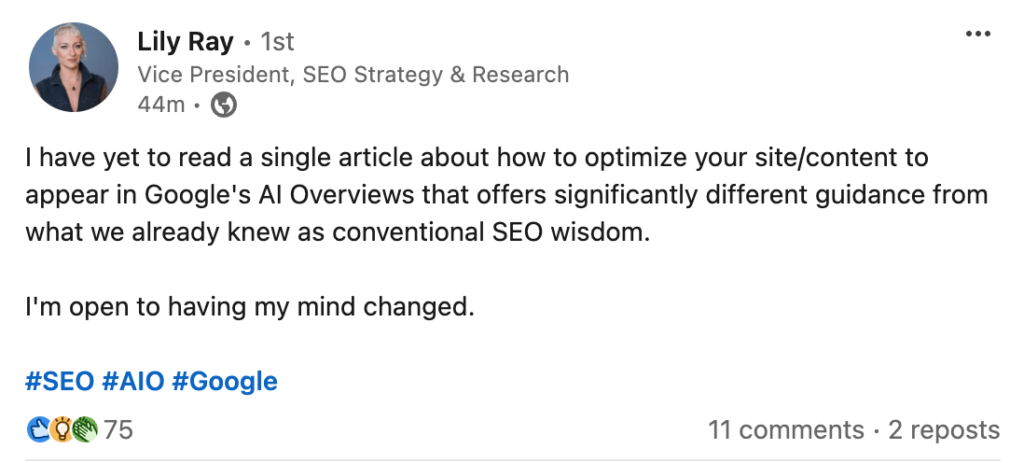
Renowned SEO industry commentator Lily Ray recently posted on Linkedin that she’s “yet to read a single article about how to optimize your site/content to appear in Google’s AI Overviews that offers significantly different guidance from what we already knew as conventional SEO wisdom.”
I understand why many people feel this way. However, while they may be subtle, experienced SEO professionals, including myself, have been discussing the nuanced differences between LLMO and SEO.
My name is Nolen Walker. I am the founder of multiple digital marketing agencies and a software company and am widely considered the best SEO salesperson in the United States.
My sales success is not based on trickery or technique but on having a good service and understanding how to convey its benefits to small business owners.
LLMO vs. SEO
Having been in the SEO industry since 2011, I’ve witnessed every major shift in the world of search engine optimization and, more importantly, how these changes have directly impacted business owners.
We had major Google algorithm updates, like Penguin and Panda, that obliterated “bad actors” in the SEO space.
More recently, we’ve seen another update, the Helpful Content Update, fundamentally alter the role of text content as a currency for ranking website pages.
This latest shift has coincided with the emergence of AI and large language models, which is how we arrived at LLMO.
Since Google and Bing have already integrated LLMs into their search engine, and ChatGPT has expanded its capabilities to search the web, optimizing websites and other forms of web content for LLMs is a natural progression of search engine marketing.
Still, many in the industry, most notably Lily Ray, have questioned how LLMO advice from long-time SEO experts like myself differs from traditional SEO advice.
An Industry in Transition
To understand how LLMO differs from SEO, you must first understand that search marketing is already markedly different than it was before ChatGPT’s emergence.
Like myself, Rand Fishkin has been in the SEO industry for over a decade and has since transitioned to audience research, a different discipline.
Rand’s shift in industries is based at least partially on his foresight into the future of search, which, as he points out, will include more zero-click searches and less website engagement.
Whether enough people have noticed or not, the behavior of the one-time website visitor has gradually shifted to a different form of consumption that includes increasing engagement with social media “shorts,” podcasts, and, of course, LLMs.
However, Rand is wise to point out that the dwindling clicks on SERPs for informational queries do not eliminate the value of Google search visibility.
In fact, there’s still great value in appearing in featured snippets and top organic rankings for Google keywords, even if its impact is more difficult to measure.
What Makes LLMO Different?
LLMO differs from SEO in that it relies more heavily on trustworthy brand mentions, public relations, and media diversification than on title tags, keyword placement, and backlinks.
As Rand points out in his SparkToro article, LLMs prioritize results using “mentions across training data.”
As a result, optimizing for LLMs involves deliberately increasing your mentions on trustworthy public domains.
This is not as binary as “link building” in its traditional SEO context, where the goal was merely to distribute website authority from one website to another.
With LLMO, service providers should target contextual brand mentions on content that matches a specific intent rather than a keyword.
Of course, these strategies overlap somewhat with the most recent SEO shifts but are still mutually exclusive in a broader sense.
Optimizing for LLM Training Data
Identifying and appearing in LLMs’ sources for training data is the key to LLMO.
But what exactly is considered training data in this world of large language models?
Below, I will provide estimates for the sources LLMs use to train and access information:
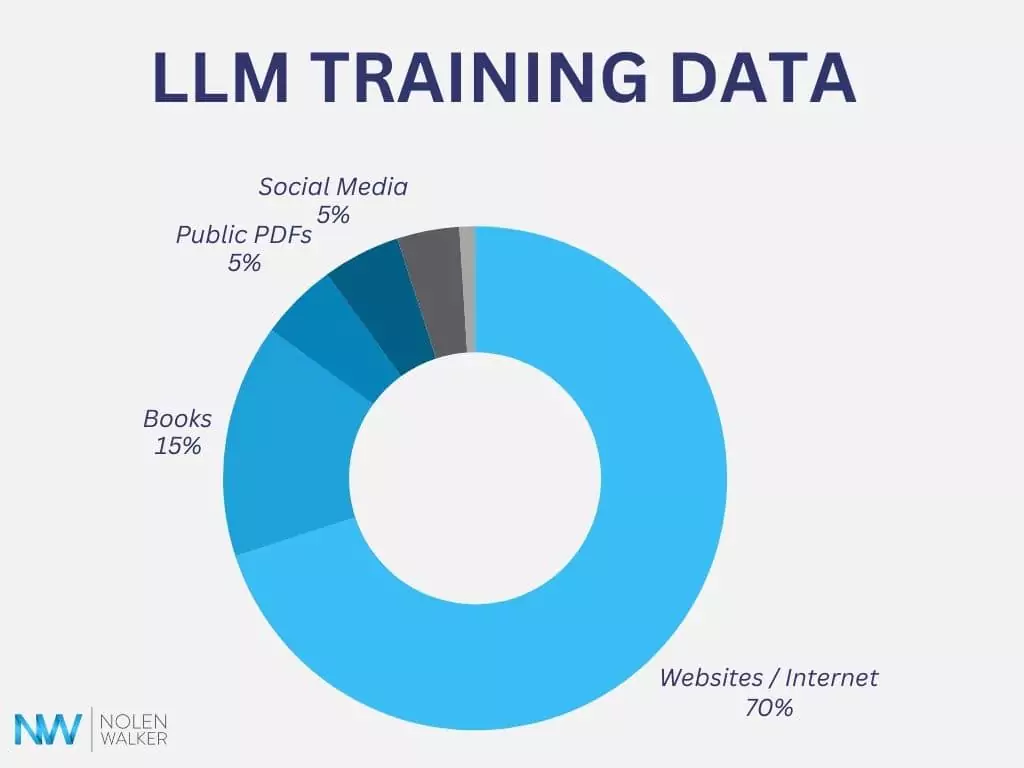
Websites / General Internet Text (60-70%)
Traditional SEO advice, like creating a branded website and reaching out to credible websites in your industry, overlaps with targeting this large section of LLM training data.
However, nuanced differences exist in your outreach priorities when attempting to appear in training data.
For example, a simple hyperlink back to your website will not suffice for teaching LLMs who you are, what you do, and why consumers should care.
Instead, you need to appear in the proper context, positioning your brand in a light that users would favorably react to.
For example, appearing in a list of the top ten companies in your local area would help train LLMs on your notoriety in that region.
Books and Academic Literature (15-20%)
Getting published research about your product or service can help LLMs learn about your brand.
The more noteworthy the publication, the more weight it will hold as LLM training data.
Public PDFs, Government Reports, and Legal Documents (5-10%)
In the early stages of SEO, PDFs, and documents indexed by search engines were sometimes referred to as the deep web.
Still, there was always anecdotal evidence that mentions within these types of documents lent more credibility to your brand as a valuable entity that Google could use to verify your legitimacy.
The same may be true of LLMOs, as LLMs use these types of documents, in some cases, for training.
Social Media and Informal Text (5-10%)
Every business should aim to appear on social media, whether through your own channels or others.
Getting mentions on YouTube Shorts, TikTok Reels, or Instagram Posts is a way for your brand to exist within the digital ether—one that LLMs may use to train their latest models.
Business Listings and Structured Data (1-3%)
Appearing in business listings directly overlaps with longstanding Local SEO advice, which stresses the importance of citations with NAP consistency for uniform phone numbers, business names, and addresses.
It’s equally important to use structured data and schema markup to associate your website and other digital entities, building a footprint that LLMs can use to verify your brand’s authenticity.
Scientific and Technical Documents (<1%)
Few companies will appear in scientific journals and technical documents, but those who do may have an edge in LLMO.
You shouldn’t worry much about getting your brand into these publications unless your business deals directly in science and scientific studies.
Integrating LLMO into SEO Services
How much you’ll have to alter your SEO services to adapt to LLMs depends on how closely you’ve paid attention to SEO shifts over the past several years.
For example, does your SEO service package still include “blog posts” as a “deliverable?”
If so, you probably don’t understand how the behavior of searchers has changed.
The shift must be dramatic for agencies still relying on archaic SEO practices to earn monthly retainers.
For one, you must focus less on text content as a ranking currency and shift your focus to user intent and E-E-A-T, which are now phrases every SEO professional should understand.
User intent defines the searcher’s goal when submitting a query on Google.
E-E-A-T stands for experience, expertise, authoritativeness, and trustworthiness, which are signals your website should demonstrate.
We can get into the weeds on how to best integrate E-E-A-T into a website, but it requires an initial understanding of how search has changed.
For agencies who’ve already shown progress in these areas, adapting to LLMO is an easier transition.
While you don’t want to abandon your existing SEO strategies, you will want to expand and emphasize audience research, brand mentions across training data and contextual relevance.
My personal contribution to this movement is DataPins, a software tool I invested millions in developing in accordance with Google’s latest guidelines.
I work with local contractors and small business owners and help them demonstrate E-E-A-T signaling on their websites while also generating context conducive to appearing in LLM answers.
As a result, the software is an all-in-one solution for modern local SEO and LLMO.
Adapting to LLMO Variables
Presenting oneself as an all-knowing expert is commonplace in today’s era of personal brands.
Meanwhile, honest business owners are struggling to adapt to technological shifts in the search landscape, and we, as an industry, are overlooking these fundamental needs.
They are uninterested in braggarts claiming to be the industry’s voice for AI, LLMs, or any other facet of the industry.
Like the early stages of search engine optimization, LLMO is a living organism that will change dozens of times per day, week, and year.
As industry experts with real-world experience, our job is not to prognosticate but rather to adapt in a way that best suits the people who rely on us to get business.
In my case, that includes plumbers, roofers, HVAC companies, and other contractors and small business owners.
When I got into this industry, I did so for them, not so I could appear on industry podcasts to celebrate my personal brand and drink cocktails with others removed from the struggle of the small business owner.
Most Important LLMs for Search Marketing
Making things easier for business owners starts with knowing where you want your brand to appear.
Like in the early days of SEO, you wanted to appear on Google, Yahoo, AltaVista, and other now-extinct search engines; the same is true of early LLM adopters.
Below, I will prioritize which LLMs are most important from a search marketing perspective:
Google AI Overviews
Google’s AI Overviews merge their existing market dominance with the emergence of AI.
Since most traditional search engine users already use Google to find businesses, optimizing for Google AI Overviews is currently the most critical component of LLMO.
ChatGPT
As the tool that took AI to the mainstream, ChatGPT Plus now features a search engine or browse the web component.
Homeowners are using ChatGPT already and expect even more potential customers to adopt it in the coming months.
Google Gemini
Google Gemini is essential to Google’s version of ChatGPT, which makes it widely accessible to Google’s existing market share.
Some ask why people use Gemini if they already have AI Overviews on traditional Google search results. Gemini is integrated with other Google products like smartphones, which future customers may use for search purposes.
Bing Chat / Bing CoPilot
Bing Chat or Bing CoPilot uses Open AI’s large language models, which also power the more popular ChatGPT.
Unlike Google, whose search engine is part of most consumers’ everyday routine, Bing has struggled to convert its OpenAI affiliation into a significant increase in market share.
Nevertheless, as the second most used traditional search engine, Bing has always been part of most businesses’ search marketing strategy, and its adoption of AI should only reemphasize that commitment.
Perplexity AI
Perplexity has defeated the odds by making a name for itself in the search marketing landscape.
While users mostly choose Perplexity for non-traditional search queries, the platform’s successful integration of AI, LLM, and web sourcing has allowed it to deliver consistently excellent answers to user search questions.
The Final Verdict on LLMO vs. SEO
LLMO and SEO certainly overlap, but applicable LLMO advice is unique from “SEO advice.”
LLMO does not rely on title tags, meta descriptions, and link equity but rather brand mentions across training data.
The methods used to achieve brand mentions across training data may resemble PR and link building to the average novice. Still, the subtle nuances can determine your brand’s visibility in LLM answers.
There was a time when PR was not considered part of SEO; in the literal sense, they are still entirely separate.
As a result, suggestions that LLMO and SEO advice are identical overlook the margins and subtleties of the contrast.
As the top SEO salesperson in the United States of America, I am proud to have implemented LLMO into my SEO service offerings at my various award-winning digital marketing agencies.
I am even more proud to have invested millions into developing software that integrates LLMO with Local SEO and digital brand building.
I will continue to dedicate my career to the hard-working small business owners who get up early, not to find their name mentioned in an article but to keep this great country running on its merits of hard work and dedication to the common good.
All in all, LLMO differs from SEO in subtle and nuanced ways, but there is undoubtedly overlap that can inform agencies and industry leaders on how to meet their clients’ emerging needs.

Author: Nolen Walker
Nolen Walker is an SEO entrepreneur with 15+ years of first-hand experience working with small businesses. He is the founder of DataPins. Nolen also hosts The Nolen Walker Podcast on Spotify.